
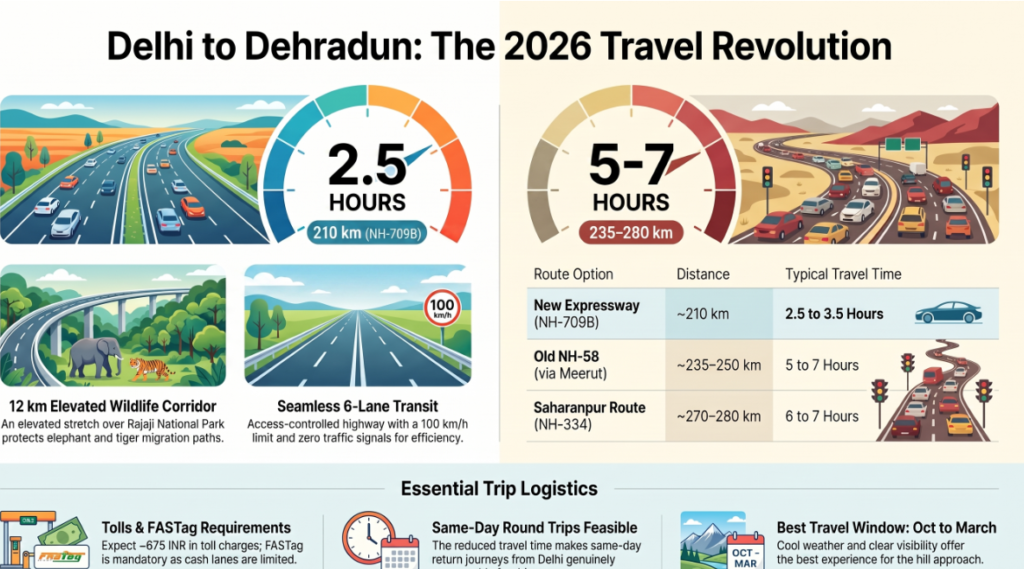
Anyone planning a trip from Delhi to Dehradun in 2026 is working with a different map than they were a year ago. The new Delhi-Dehradun Expressway opened to traffic in April 2026, and it has changed both the distance and the time on this route in a real way, not just a marketing claim.
This guide breaks down the actual numbers, the route options, what a cab ride costs, and the practical details that matter once you are sitting in the car.
Delhi to Dehradun Distance by Route
There is no longer a single answer to “how far is Dehradun from Delhi.” The distance depends on which road you take, and the gap between options is now larger than it used to be.
| Route | Distance | Typical Travel Time |
|---|---|---|
| Delhi-Dehradun Expressway (NH-709B) | ~210 km | 2.5 to 3.5 hours |
| Old NH-58 via Meerut, Muzaffarnagar, Roorkee | ~235 to 250 km | 5 to 7 hours |
| Saharanpur route (NH-334) | ~270 to 280 km | 6 to 7 hours |
The expressway runs from Akshardham in East Delhi through Baghpat, Baraut, Shamli, and Saharanpur, before entering Uttarakhand and reaching Dehradun. It is a six-lane, access-controlled highway with a 100 km/h speed limit and no traffic signals along the main stretch, which is the biggest reason travel time has dropped so sharply.
What Changed With the New Expressway
For years, a Delhi to Dehradun cab ride meant a 5 to 6 hour grind through Meerut and Roorkee, with traffic bottlenecks near both towns eating into the schedule. The expressway removes most of that friction.
It also includes a 12 km elevated wildlife corridor over Rajaji National Park, built to let traffic pass without disturbing the elephant and tiger movement in the reserve below. Drivers will notice this stretch even without knowing the engineering behind it, since the road simply lifts above the forest canopy for several kilometres.
For travelers, the practical upshot is that a same-day round trip from Delhi to Dehradun, which used to be exhausting, is now genuinely manageable.
Toll Charges on the Delhi-Dehradun Route
The expressway has five toll plazas along its length. A one-way trip by car currently costs roughly 670 to 675 rupees for vehicles travelling the full corridor, with lower charges for shorter entry and exit segments. Keep a FASTag loaded before starting the journey, since cash lanes are limited on this stretch.
The older NH-58 route has lighter tolling, usually in the 300 to 500 rupee range, but the time saved on the expressway is usually worth the extra toll cost for most travelers.
Best Time to Travel
October to March is the most comfortable window for this drive, with cool, clear weather and good visibility on the hill approach near Dehradun. Summer months bring heat on the plains but cooler relief once you near the foothills, which is part of why Dehradun has long been a warm-weather escape from Delhi.
Monsoon season, roughly July to September, is worth avoiding if possible. The stretch near Rajaji National Park and the final approach into Dehradun can see slower going during heavy rain, even with the new road surface.
Choosing the Right Cab for the Journey
A sedan works fine for two to three passengers with normal luggage and is the most economical option for the expressway route. For families or groups of four to six with extra bags, an Innova or similar MUV gives more legroom and boot space, which matters more on a journey that still runs over two hours even at expressway speed.
One thing worth checking before booking: confirm whether the driver and vehicle are cleared for the new expressway route rather than only the old NH-58 road. Most updated fleets now default to the expressway, but it is a fair question to ask, especially for advance bookings made before the highway’s full opening in April 2026.
- Sedan (Dzire, Etios or similar): best for 2 to 3 passengers, lowest fare
- Innova or Ertiga: best for families or groups with luggage
- Tempo Traveller: best for groups above 8, common for Char Dham connections via the Haridwar-Roorkee spur
Stopovers Along the Way
Even at expressway speed, a short break is worth it. Roorkee, known for its IIT campus, sits just off the route and makes a reasonable stretch-your-legs stop. Travelers taking the older Saharanpur road often stop at the Shakumbhari Devi Temple or pause in Meerut, which has some genuine historical sites tied to 1857, including the Augharnath Temple.
If the destination is actually Rishikesh, Haridwar, or the Char Dham circuit rather than Dehradun itself, the expressway’s Saharanpur-Roorkee-Haridwar spur offers a direct link without backtracking through Dehradun city.
Frequently Asked Questions
-
What is the actual distance from Delhi to Dehradun?
- Via the new expressway it is approximately 210 km. Via the older NH-58 route it is approximately 235 to 250 km.
-
How long does the drive take by cab?
- About 2.5 to 3.5 hours on the expressway, including a short break. The old route takes 5 to 7 hours depending on traffic near Meerut and Roorkee.
-
Is the new expressway open for cab bookings now?
- Yes. The expressway was inaugurated in April 2026 and is fully operational, with most cab operators now routing trips through it by default.
-
What does a one-way cab fare from Delhi to Dehradun cost?
- Fares vary by vehicle type and operator, but expect a sedan to cost less than an Innova or MUV for the same trip, with toll charges added separately.
-
Which is better for a same-day return trip, train or cab?
- With the expressway’s 2.5-hour travel time, a same-day round trip by cab is now realistic for the first time, something that was difficult on the older route.