
If you have spent any time browsing Indian car forums or asking friends about their next family vehicle purchase, you have probably noticed how much sunroofs dominate the conversation. A glass roof has gone from being a luxury feature to something almost every buyer seems to want, whether for the sense of open space, the Instagram-worthy pictures, or simply the feeling of fresh air on a highway drive.
Against this backdrop, the Toyota Innova Crysta continues to hold its ground as one of India’s most trusted MPVs. It has carried families, served as the workhorse of corporate fleets, and ferried countless travellers across the country for years. Its reliability is almost legendary in the Indian market.
Yet one question keeps surfacing: does the Innova Crysta come with a sunroof? It is a fair question, and the answer might surprise buyers who have been assuming Toyota would eventually add one. This guide covers everything you need to know.
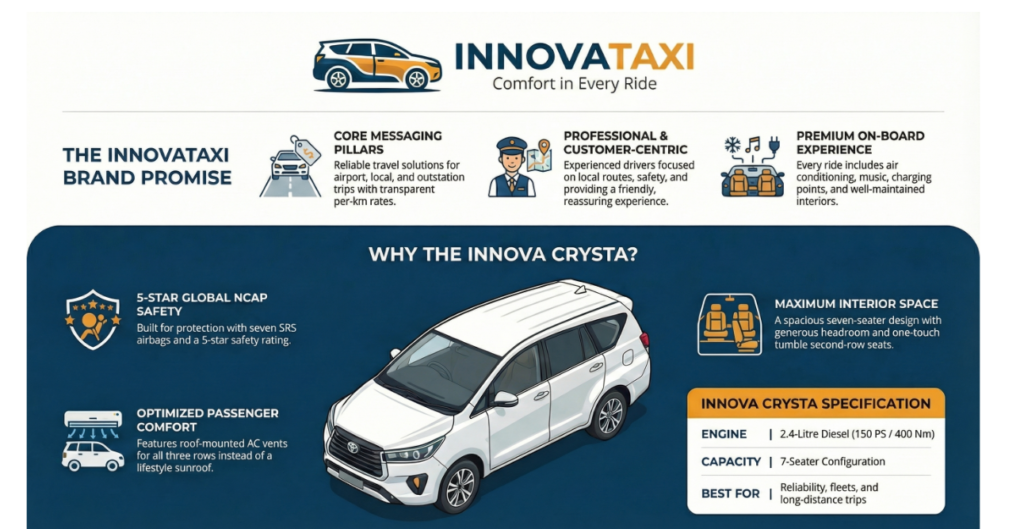
The Short Answer: No Sunroof on the Innova Crysta
None of the 2025 variants of the Toyota Innova Crysta come with a factory-fitted sunroof. This applies across all trim levels, from the entry-level GX right through to the fully loaded ZX. Toyota has not offered a sunroof on the Crysta at any point in the model’s history in India, and that remains the case with the current lineup.
| Quick Fact: Whether you are looking at the GX, VX, or ZX variant of the 2025 Innova Crysta, none of them include a sunroof as standard or optional equipment. |
This is not an oversight or a feature Toyota forgot. It is a deliberate decision rooted in how Toyota has positioned this vehicle and who it is built for.
Why Doesn't the Innova Crysta Have a Sunroof?
Toyota’s Design Philosophy: Practicality Over Lifestyle Features
Toyota built the Innova Crysta around a very specific purpose: to be the most practical, spacious, and reliable seven-seater money can buy in its segment. Adding a sunroof would require cutting into the roofline, which directly reduces headroom inside the cabin, particularly for second and third-row passengers.
In a vehicle where three rows of adults need to sit comfortably over long distances, Toyota made the conscious call to prioritise interior space over a feature that many buyers in the Crysta’s target demographic rarely use.
Roof-Mounted AC Vents Take Priority
One of the Innova Crysta’s most appreciated practical touches is its roof-mounted AC vents that serve rear passengers. This layout allows cool air to reach the second and third rows effectively, which matters enormously on long road trips in Indian conditions.
A sunroof and roof-mounted AC vents are essentially incompatible in the same cabin design. Toyota chose the feature that has a direct, daily impact on passenger comfort over one that is primarily aesthetic.
Target Audience: Families, Fleets, and Long-Distance Travel
The Innova Crysta has always served a different audience than lifestyle-oriented SUVs. Its buyers tend to be large families planning cross-state road trips, business owners running airport transfers, or fleet managers who need dependable high-capacity vehicles.
For these buyers, legroom, luggage space, fuel economy, and mechanical reliability rank far higher than a glass roof panel. Toyota’s research and sales data have consistently supported this positioning.
What the Innova Crysta Does Offer Instead
The absence of a sunroof should not be mistaken for a lack of features. The 2025 Innova Crysta comes loaded with equipment that genuinely matters for daily use and long-distance travel.
- 5-star Global NCAP safety rating backed by seven SRS airbags, making it one of the safer MPVs in its class
- One-touch tumble second-row seats that fold and slide forward with a single action, giving easy access to the third row without asking passengers to squeeze through
- Front clearance sonar with MID indication, helping drivers navigate tight parking spots and congested city lanes with confidence
- Spacious seven-seater cabin with generous headroom and legroom across all three rows
- A punchy 2.4-litre diesel engine producing 150 PS and 400 Nm of torque, available in both manual and automatic transmissions
- Roof-mounted rear AC vents that ensure even the third row stays cool on summer drives
For a buyer who genuinely needs a practical family mover or a reliable fleet vehicle, this package is hard to beat in its segment.
Want a Sunroof? The Innova HyCross Is Your Answer
If a sunroof is non-negotiable for you, Toyota has an answer within its own lineup: the Innova HyCross.
The HyCross offers a panoramic sunroof complete with mood lighting and, impressively, also retains roof-mounted AC vents. Toyota managed to include both by redesigning the cabin around a monocoque platform rather than the body-on-frame structure used by the Crysta. This is a first-in-segment combination that few other MPVs can claim.
Key Differences Between the Crysta and HyCross
Feature | Innova Crysta | Innova HyCross |
Sunroof | No | Panoramic sunroof |
Powertrain | Diesel (2.4L) | Hybrid (petrol + electric) |
Body Structure | Body-on-frame | Monocoque |
Starting Price | ~Rs. 18.85 lakh | Higher segment |
Best For | Reliability, fleets, long trips | Lifestyle + practicality |
Who Should Consider the HyCross?
The HyCross makes sense if you want the Toyota family MPV experience but also value lifestyle features like a panoramic roof, a quieter cabin thanks to hybrid operation, and a more car-like driving feel from the monocoque construction. The trade-off is a higher price and a petrol-hybrid powertrain rather than the Crysta’s proven diesel.
Can You Add an Aftermarket Sunroof to the Innova Crysta?
Technically, yes. Aftermarket sunroofs are widely available in India and can be fitted by specialist workshops. You will typically find two main types: pop-up manual sunroofs, which are the more affordable option, and motorised panoramic sunroofs, which add a powered glass panel similar to what you see on factory-fitted units.
The Case For Aftermarket
- Allows you to personalise your vehicle and get the feature you want
- Relatively accessible pricing compared to upgrading to a whole new model
- Can enhance the appeal of the vehicle if you plan to resell
The Case Against
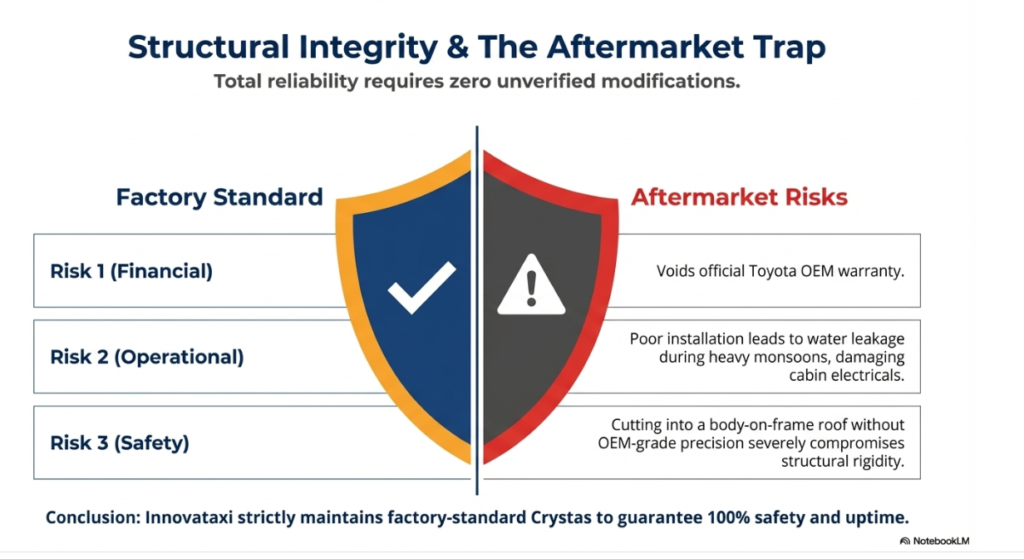
- Toyota’s official warranty does not cover damage caused by or arising from aftermarket modifications, including sunroof installations
- Poor installation can lead to water leakage, especially during heavy Indian monsoons, causing long-term damage to the cabin, electrical systems, and upholstery
- Cutting into the roof of a body-on-frame vehicle without OEM-grade precision can affect structural rigidity
- Resale buyers are often wary of vehicles with aftermarket modifications, which can reduce the vehicle’s value
Expert Recommendation: If a sunroof is important to you, upgrading to the Innova HyCross is a much safer path than retrofitting one on the Crysta. The factory-integrated approach preserves waterproofing, structural integrity, and your warranty coverage. |
Innova Crysta 2025: Key Specs at a Glance
Specification | Details |
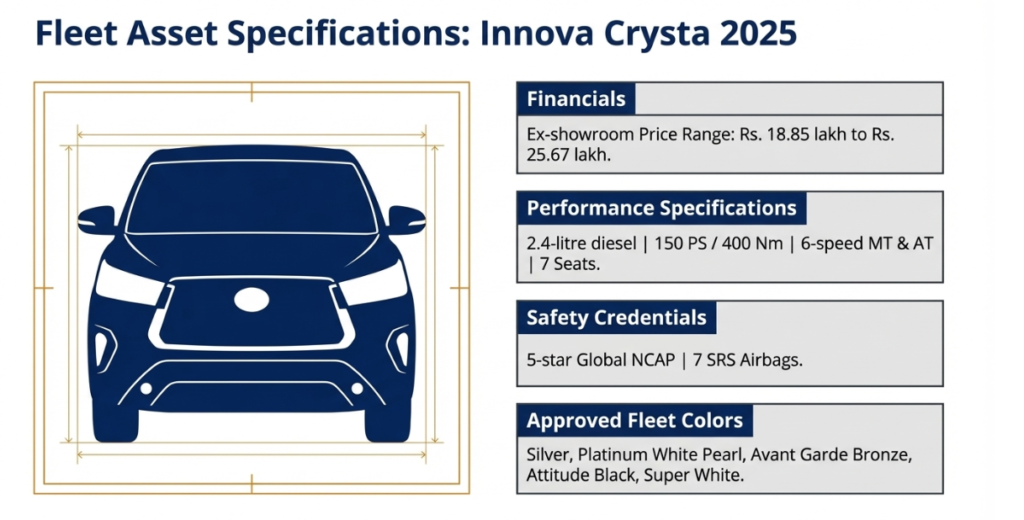
Price Range | Rs. 18.85 lakh to Rs. 25.67 lakh (ex-showroom) |
Engine | 2.4-litre diesel |
Power | 150 PS |
Torque | 400 Nm |
Transmission | 6-speed manual and 6-speed automatic |
Seating | 7 seats |
Sunroof | Not available on any variant |
Safety | 5-star Global NCAP, 7 SRS airbags |
Available Colours | Silver, Platinum White Pearl, Avant Garde Bronze, Attitude Black, Super White |
Conclusion: Know What You Are Buying
The Toyota Innova Crysta is not a vehicle for sunroof seekers. It never has been, and Toyota has no plans to change that. What it is, though, is one of the most dependable, spacious, and capable seven-seaters on Indian roads. Its diesel engine has earned a reputation for longevity, its cabin handles the demands of large families and long highway runs with ease, and its safety credentials are among the strongest in its segment.
If you are buying for reliability, cabin space, and the confidence that comes with a proven Toyota platform, the Crysta is an excellent choice. If a sunroof is a feature you genuinely cannot do without, the honest answer is that the Innova HyCross is the vehicle Toyota has built for you.
There is no wrong answer here. It really comes down to what matters most to you and how you plan to use your vehicle.