
If you have ever stood at a Delhi traffic signal on a hot afternoon and thought “I need to get out of this city,” you are not alone. Millions of people in Delhi feel this way every single day. And one of the best destinations to escape to, without fighting the Shimla or Manali crowds, is a quiet little hill town called Kanatal.
Tucked away in the Garhwal Himalayas at around 8,000 feet above sea level, Kanatal sits between two popular towns: Mussoorie and Chamba. It does not have malls or busy markets. What it does have is thick deodar forests, cool mountain air, a sky full of stars at night, and some of the most peaceful mornings you will ever experience. And the best way to get there from Delhi? A comfortable cab ride through the Himalayan foothills.
This guide covers everything you need to know about the Delhi to Kanatal cab journey, from booking the right vehicle to finding the best places to stop along the way, and what to do once you arrive.
Why Choose a Cab Over a Bus or Train?
Before we get into the details, it is worth explaining why a cab is the smartest choice for this particular route.
Kanatal does not have a railway station. The closest major station is Dehradun, which is still about 75 km away from Kanatal on winding mountain roads. Taking a train to Dehradun and then arranging a local taxi involves extra coordination, extra waiting, and extra cost if you are travelling as a group.
Buses do run to Chamba or Mussoorie from Delhi’s ISBT Kashmere Gate, but they drop you at the nearest town and you still need to arrange the final stretch to Kanatal, which requires a separate cab.
A direct cab from Delhi to Kanatal solves all of this. You get picked up from your doorstep, you control the schedule, you stop wherever you want, and you arrive at your hotel or campsite without any last-minute scrambling. If you are a family with luggage, or a group of friends on a weekend trip, this convenience is well worth the cost.
How Long Does the Journey Take?
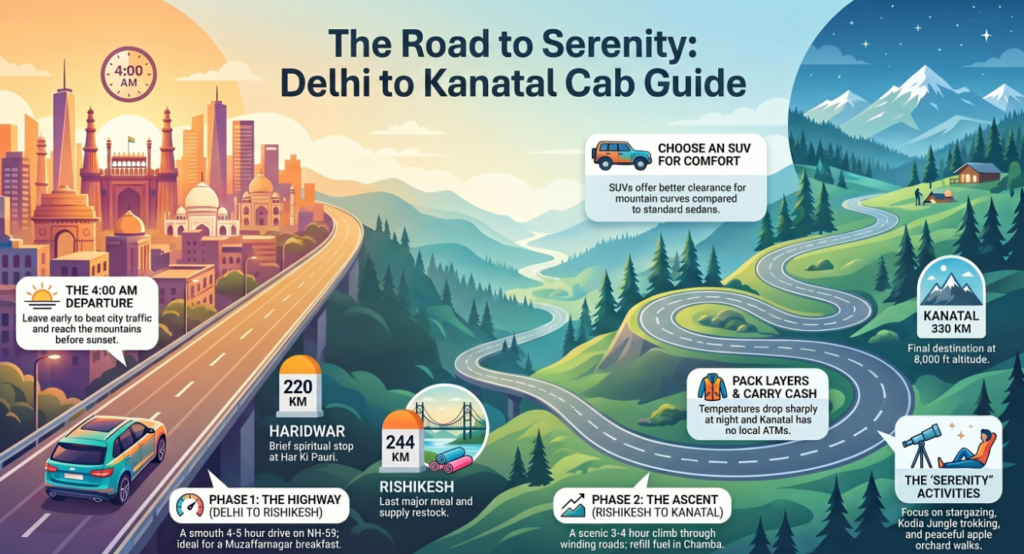
The distance from Delhi to Kanatal is around 330 kilometres, depending on your starting point in the city and the exact route taken. The drive takes anywhere between 8 and 10 hours.
The journey has two distinct phases. The first part, from Delhi to Haridwar or Rishikesh, is a straightforward highway drive on NH-58 or NH-34. This stretch is smooth, fast, and takes roughly 4 to 5 hours. The second part, from Rishikesh or Haridwar onwards through Chamba and up to Kanatal, is a mountain road that takes 3 to 4 hours. This section involves curves, gradients, and narrower roads, but it is also the most scenic part of the drive.
Most travellers prefer to leave Delhi early, between 4 AM and 6 AM, so they can cover the highway portion before heavy traffic builds up and still reach Kanatal before sunset. Driving on mountain roads after dark is not recommended, especially if you are not familiar with the route.
Booking Your Cab: What to Look For
You have several options when it comes to booking a cab for this journey.
Outstation cab apps like Ola Outstation and Zoom Car are convenient and give you upfront pricing. These platforms are reliable for booking a sedan or SUV, and you can cancel or reschedule with reasonable notice. However, prices can be higher during peak travel seasons like summer (May to June) and winter holidays (December to January).
Local Delhi travel agents often offer better rates, especially for round trips. If you know you will be returning from Kanatal on a fixed date, booking a round-trip cab with a local operator can save you a meaningful amount compared to booking two separate one-way rides.
Dedicated cab services that specialize in Uttarakhand routes are another strong option. These drivers know the mountain roads well, understand the stops travellers typically like, and are experienced with Kanatal’s specific route. One service worth considering for your Delhi to Kanatal trip is Innova Taxi, which offers outstation cabs with experienced drivers at competitive rates.
When booking, always confirm the following: whether the price includes tolls and hills charges, whether the driver has experience on mountain roads, whether the cab is an SUV or just a standard sedan, and what the cancellation policy looks like.
Sedan or SUV? For two people travelling light, a sedan like a Dzire or Etios works fine for the highway portion. But once you hit the mountain roads after Rishikesh, an SUV or a high-clearance vehicle like an Innova or Scorpio gives a noticeably more comfortable ride. If you are a group of four or more, or if you are carrying large bags and camping gear, always go for an SUV.
The Route: Step by Step
Here is a clear breakdown of the route from Delhi to Kanatal.
Delhi to Haridwar (roughly 220 km)
The route begins on NH-58 from Delhi, passing through Ghaziabad, Meerut, and Muzaffarnagar before reaching Haridwar. This stretch is mostly a wide four-lane highway and is generally smooth driving in the early morning hours. Expect some traffic around Meerut and Muzaffarnagar during peak hours, which is one more reason to leave Delhi before sunrise.
If you are not in a hurry, a quick 20-minute stop at Haridwar is a lovely idea. The Har Ki Pauri ghat in the early morning is genuinely beautiful, and you can grab tea from the stalls near the riverbank. Just remember that Haridwar is a religious town so non-vegetarian food and alcohol are not available here.
Haridwar to Rishikesh (roughly 24 km)
From Haridwar, you drive to Rishikesh, which takes about 30 to 40 minutes. Rishikesh is a popular pit stop for most travellers on this route. There are good cafes here, proper washroom facilities, and you can stock up on snacks, water, and any last-minute supplies you need before the mountains.
The Laxman Jhula and Ram Jhula areas have several cafes that serve good food and great views of the Ganga. Give yourself at least 45 minutes here if you plan to eat a proper meal.
Rishikesh to Chamba (roughly 60 km)
From Rishikesh, the route heads towards Devprayag and then Chamba. This is where the mountains properly begin. The road hugs the Bhagirathi river in parts and passes through Narendra Nagar and Devprayag before reaching Chamba. The drive through this section is beautiful but takes longer than the mileage suggests because the roads are curved and narrow in places.
Chamba is a small, quiet town with a few dhabas and petrol pumps. This is an important landmark: fill up on fuel here because petrol pumps become sparse after this point. Also grab a light snack and use the restroom facilities in Chamba.
Chamba to Kanatal (roughly 38 km)
The final stretch from Chamba to Kanatal is the most dramatic part of the journey. The road climbs steadily through dense forests, and you will notice the temperature dropping noticeably as you gain altitude. The views open up at several points, and on a clear day you can see snow-capped peaks in the distance.
Kanatal itself is a small settlement spread across a ridge. There is no single “town centre.” Most camps and resorts are spread along a 10 to 15 km stretch of road, so make sure you have the exact GPS location of your accommodation ready before you arrive.
Best Stopping Points Along the Way
Muzaffarnagar or Roorkee for an early breakfast. If you leave Delhi at 5 AM, you will reach this area around 7 to 7:30 AM, which is perfect timing for a proper breakfast. There are reliable highway dhabas here that serve hot parathas, chai, and omelettes.
Haridwar for a brief spiritual stop. Even 20 minutes by the Ganga at Har Ki Pauri is refreshing and calming. The morning aarti atmosphere is unlike anything in a city.
Rishikesh for a full meal. This is your last proper town before the mountains, so eat well. There are options ranging from South Indian breakfast places to cafes serving sandwiches and smoothies for the more internationally-inclined traveller.
Chamba for fuel and a snack. Non-negotiable. Fill the tank completely here.
What to Do in Kanatal
Once you arrive, the pace of life changes immediately. There is no rushing in Kanatal. Here is what most visitors spend their time doing.
Camping under the stars. Kanatal is one of the best camping spots in Uttarakhand. Several camps set up Swiss tents with beds, attached bathrooms, and bonfires in the evening. On a clear night, the sky is extraordinary. Far from city light pollution, you can see the Milky Way properly for perhaps the first time in your life.
Trekking to Kodia Jungle. There is a beautiful trail through the Kodia forest near Kanatal that takes you through thick oaks and rhododendrons. It is not a difficult trek and can be completed in a few hours. The forest is quiet and the birdwatching here is excellent.
Surkanda Devi Temple Trek. About 15 km from Kanatal, the Surkanda Devi temple sits at 9,995 feet and offers a panoramic view of the Himalayan ranges. The trek to the temple from Kaddukhal (the base) is about 2 km and takes roughly an hour each way. The view from the top on a clear morning is genuinely spectacular.
Apple orchard walks. In the right season, the area around Kanatal is dotted with apple and peach orchards. Local homestays often let guests walk through their orchards, which is a simple but lovely experience.
Sitting around a bonfire. In the evenings, most camps arrange bonfires. This is when the temperature drops sharply (even in summer), so keep warm layers handy. The combination of stars above, fire in front, and complete silence all around is the reason people fall in love with Kanatal.
Where to Stay in Kanatal
Kanatal offers accommodation across different budgets.
Budget options include simple guesthouses and dorm-style camping tents. These typically cost between Rs 800 and Rs 1,500 per person per night, sometimes with meals included.
Mid-range camps and cottages are the sweet spot for most travellers. These offer comfortable tents or wooden cottages with attached bathrooms, meals, and guided activities. Expect to pay between Rs 2,500 and Rs 5,000 per person per night for a package that includes dinner and breakfast.
Luxury eco-resorts have also arrived in Kanatal in recent years. These properties offer spacious rooms with mountain views, in-house restaurants, and curated activities. Prices start around Rs 7,000 per night and go up significantly.
One important tip: book your accommodation in advance, especially if you are visiting between April and June (peak season), or during the Christmas and New Year period. Kanatal has limited inventory and good properties fill up fast.
Practical Tips Before You Go
Pack layers, not just warm clothes. Mountain weather changes quickly. You might feel warm at noon and freezing by 4 PM. A light jacket, a fleece or sweater, and one proper warm layer should cover most situations.
Carry cash. Kanatal does not have an ATM. The nearest one is in Chamba or Mussoorie. Withdraw enough cash before you leave the highway towns.
Expect patchy mobile network. Most networks have spotty coverage in Kanatal. BSNL tends to work slightly better in remote Uttarakhand areas, but do not count on constant connectivity. Download offline maps on your phone before you start the journey.
Do not drive on mountain roads at night. Seriously, this is not something to take lightly. The roads after Rishikesh have no streetlights, the curves are blind, and visibility drops sharply after sunset. Plan your timing so you reach Kanatal before dark.
Carry a basic medical kit. Include tablets for headache, nausea, and mild altitude sickness. Some people feel lightheaded at 8,000 feet, especially if they come straight from the plains without any acclimatization.
Fuel and food for the driver. If you have hired a cab for a multi-day trip, your driver will be staying in or near Kanatal while you enjoy your holiday. Make sure your booking includes driver accommodation, or confirm this arrangement separately. A considerate traveller also makes sure the driver has eaten and is comfortable.
How Much Does the Cab Cost?
Cab prices vary based on the vehicle type, the operator, the season, and whether it is a one-way or round trip. As a rough guide:
A one-way trip from Delhi to Kanatal in a sedan costs somewhere between Rs 4,500 and Rs 6,500. In an SUV or Innova, the price ranges from Rs 7,000 to Rs 10,000. Round trips usually offer a 10 to 15 percent saving compared to two separate one-way bookings. Tolls and hills charges are sometimes included in the quoted price and sometimes added separately, so always confirm this at the time of booking.
Peak season prices (April to June, December to January) tend to run 20 to 30 percent higher than the regular rate. Booking a few days in advance generally gets you a better deal than booking last-minute.
Is the Drive Worth It?
Absolutely. The Delhi to Kanatal cab journey is one of those drives where the road itself becomes part of the experience. The transition from flat, noisy highway to quiet mountain roads happens gradually, and by the time you are winding through the deodar forests above Chamba, the city feels very far away.
Kanatal is not for everyone. If you want shopping, restaurants, nightlife, and tourist crowds, this is not your destination. But if you want clean air, silence, star-filled skies, and a genuine sense of being away from the world, Kanatal delivers everything it promises.
Pack your bags, book your cab, set your alarm for an early morning departure, and go. Sometimes the best thing you can do for yourself is to leave.
Total driving distance: approximately 330 km. Estimated drive time: 8 to 10 hours. Best time to visit: October to November and March to June.