
Haridwar is one of the most sacred cities in India. It sits right at the point where the Ganges river leaves the Himalayas and flows into the plains below. For pilgrims across the country, Haridwar is the spiritual gateway to the mountains, and almost every person heading for the Char Dham Yatra begins their journey here. The city hums with prayers, morning aartis, and the constant movement of devotees who come to take a dip in the holy river before venturing higher into the hills.
Kedarnath Temple is one of the twelve Jyotirlingas and holds an extraordinary place in Hindu faith. Located at an altitude of 3,583 metres in the Garhwal Himalayas, the temple is dedicated to Lord Shiva and is part of the Char Dham circuit that includes Yamunotri, Gangotri, and Badrinath. The temple opens only for about six months every year, roughly from May to November, and during this window it draws hundreds of thousands of pilgrims, trekkers, and spiritual seekers.
Before you set out on this journey, understanding the exact distance, the different routes available, and what to expect along the way can make a real difference to your experience. A trip that feels overwhelming on paper becomes manageable and even joyful when you know what lies ahead. This guide covers everything you need to plan your journey from Haridwar to Kedarnath with full confidence.
Haridwar to Kedarnath Distance Overview

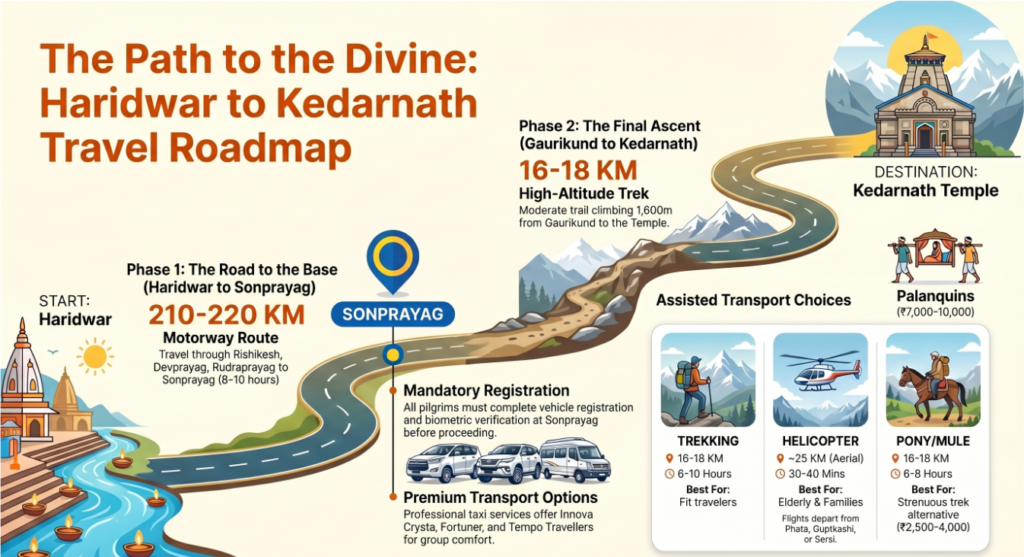
The total distance from Haridwar to Kedarnath is approximately 240 to 260 km when you combine the road journey with the trek on foot. The road will carry you as far as Sonprayag, which is the last point any motorised vehicle is allowed to reach. From there, you continue to Gaurikund by a short shared jeep ride, and then the actual trek to the temple begins.
Here is a quick summary of the three main travel options available to pilgrims:
| Mode | Route | Distance | Travel Time | Best For |
| By Road | Haridwar to Sonprayag | 210 to 220 km | 8 to 10 hours | All travellers |
| By Trek | Gaurikund to Kedarnath | 16 to 18 km | 6 to 10 hours | Fit travellers |
| By Helicopter | Phata or Guptkashi to Kedarnath | Approx. 25 km aerial | 30 to 40 minutes | Elderly and families |
Haridwar to Kedarnath by Road
3.1 Route Details
The road journey from Haridwar takes you deep into the Garhwal Himalayas, following the course of the Ganga and its tributaries through some of the most dramatic scenery in northern India. The route passes through several important towns and river confluences that are themselves worth pausing to appreciate.
The route goes: Haridwar > Rishikesh > Devprayag > Rudraprayag > Guptkashi > Sonprayag > Gaurikund
Sonprayag is the last motorable point before Kedarnath. From here, shared jeeps run a short 5 km stretch to Gaurikund, where the actual trek begins. It is mandatory to stop at Sonprayag for vehicle registration and biometric verification before proceeding further.
3.2 Distance and Travel Time
The road distance from Haridwar to Sonprayag is approximately 210 to 220 km. Under normal road and weather conditions, this drive takes around 8 to 10 hours. However, that number can stretch considerably during peak pilgrimage season in May and June, or if there are landslide blockages on the mountain stretches closer to Guptkashi and Sonprayag.
Starting your journey early in the morning, ideally before 5 AM from Haridwar, is strongly recommended. An early start helps you clear the busier stretches before traffic builds up, and the morning light on the river confluences at Devprayag and Rudraprayag is something worth experiencing.
3.3 Road Conditions and Tips
Mountain roads in Uttarakhand are scenic but unpredictable. Landslides are common during and after the monsoon months, and even in peak season a heavy overnight rain can block the road for several hours. Always keep your schedule flexible and check road conditions before you leave.
- Fuel up your vehicle in Rishikesh before heading into the mountains. Petrol stations become sparse after Rudraprayag and prices tend to be higher in the hills.
- Good food stops are available at Devprayag, Rudraprayag, and Guptkashi. These towns have decent dhabas serving hot and filling meals.
- Check road condition updates through the BRO helpline or SDRF Uttarakhand social media channels the night before you travel.
- Private cabs from Haridwar to Sonprayag typically cost between Rs. 4,000 and Rs. 6,000 depending on the vehicle type. Shared taxis and GMOU buses are cheaper but slower.
- Carry a basic first aid kit, dry snacks, and enough water in the car. There are long stretches on this route with no services at all.
- Landslide-prone zones exist between Rudraprayag and Guptkashi. If you see fresh debris on the road, wait for clearance rather than attempting to cross.
Trek Distance from Sonprayag to Kedarnath
4.1 The Trek Route
Once you reach Sonprayag, you will need to take a shared jeep for the remaining 5 km stretch to Gaurikund. This short ride costs around Rs. 30 to Rs. 50 per person and runs frequently throughout the morning hours. Gaurikund sits at an altitude of around 1,982 metres and serves as the official base camp for the Kedarnath trek.
Gaurikund itself is a small but lively settlement with tea stalls, basic hotels, pony and palanquin booking counters, and the famous hot water kund where many pilgrims take a ritual dip before beginning the ascent. The water in the kund is naturally warm and is considered sacred.
The trek route goes: Gaurikund > Jungle Chatti > Bheem Bali > Lincholi > Kedarnath Temple
4.2 Trek Distance and Time
The trek from Gaurikund to Kedarnath covers approximately 16 to 18 km of mountain trail. A reasonably fit person walking at a steady pace can complete this in 6 to 8 hours. Those who are slower, stopping frequently for rest, or carrying heavy bags may take 9 to 10 hours.
The trail climbs from about 1,982 metres at Gaurikund to 3,583 metres at the Kedarnath Temple, which means a total altitude gain of over 1,600 metres. The path is paved for most of its length, well-marked with signboards, and has regular rest stops, tea shops, and first aid posts along the way. The trail follows the Mandakini river for a good portion of the journey, and the sound of the rushing water is a constant companion on the ascent.
4.3 Trek Options
Not everyone who visits Kedarnath does so on foot. Several assisted options exist to make the journey accessible to pilgrims of all ages and physical conditions.
Walking: The most traditional and rewarding way to complete the pilgrimage. The effort of the walk is considered part of the spiritual experience itself. The trail is challenging but very manageable for anyone in reasonable health.
Pony or Mule: Available for booking at Gaurikund. The cost is approximately Rs. 2,500 to Rs. 4,000 for a one-way journey. A good option for those who cannot walk the full distance but want to avoid the cost of a helicopter. Government-fixed rates are displayed at the booking counters.
Palanquin (Doli): Carried by four bearers, this is the most comfortable but also the most expensive option at Rs. 7,000 to Rs. 10,000 one way. It is particularly suitable for elderly pilgrims or those with physical limitations who still wish to make the yatra.
4.4 Trek Preparation Tips
- Spend at least one night in Guptkashi or Sonprayag before the trek if you are travelling from the plains. This gives your body time to adjust to the altitude and significantly reduces the risk of mountain sickness.
- Wear layered clothing. Even in May and June, temperatures on the trail can drop sharply in the afternoon when clouds roll in and winds pick up near the higher stretches.
- Carry trekking poles if you have them. The trail has steep sections where poles provide excellent stability, particularly on the descent when your knees are under more pressure.
- Wear proper trekking shoes with good grip. Sandals, slippers, or flat-soled footwear are genuinely dangerous on the stone trail, especially if it has rained.
- Drink water regularly throughout the trek and carry energy snacks such as nuts, dried fruits, glucose biscuits, and chocolates. Shops exist on the trail but can be crowded and slow during peak hours.
- If you feel breathless, dizzy, or develop a persistent headache, do not push forward. Descend to a lower altitude, rest, and hydrate. These are early signs of altitude sickness and must be taken seriously.
- Do not attempt to start the trek late in the afternoon. Start from Gaurikund by 5 to 6 AM at the latest to ensure you reach Kedarnath well before dark.
Haridwar to Kedarnath by Helicopter
5.1 Helicopter Route and Departure Points
Helicopter services to Kedarnath do not depart from Haridwar directly. You will need to travel by road to one of the designated helipads first. The main departure points are Phata, Guptkashi, and Sersi, all of which are located on the Kedarnath highway, roughly 30 to 50 km before Sonprayag.
Phata is the most popular and busiest helipad. Guptkashi is a reliable alternative and is often used when Phata slots are fully booked. Sersi tends to see fewer crowds and can sometimes offer more availability during peak season.
5.2 Distance and Flight Duration
The helicopter flight from any of these helipads to the Kedarnath helipad takes approximately 30 to 40 minutes. The aerial views of the Mandakini valley, the surrounding peaks, and the glacier terrain near the temple are extraordinary, and many travellers consider the flight itself one of the highlights of the trip.
5.3 Cost and Booking
Helicopter tickets for Kedarnath are in extremely high demand during the season and should be booked as far in advance as possible. Prices for a one-way ticket generally range from Rs. 4,000 to Rs. 8,500 per person, depending on the helipad, the operator, and how close you are booking to the peak travel dates.
- Book through the official IRCTC website, the Uttarakhand Tourism portal, or authorised operators such as Pawan Hans, UTAir, and Himalayan Heli Services.
- Always carry a valid government-issued photo ID that matches the name on your ticket. Identity checks at helipads are strict.
- Helicopter flights operate only in good visibility. Cloudy mornings or rainy weather frequently cause delays and cancellations. Build buffer days into your itinerary to account for this.
- The standard weight limit per passenger including baggage is 80 kg. Excess weight may attract additional charges or may not be permitted at all.
- Refund policies vary by operator. Check cancellation terms carefully before booking, especially if your travel dates are flexible.
5.4 Pros and Cons
Advantages: Saves 6 to 10 hours of strenuous trekking. Ideal for elderly pilgrims, those with heart or respiratory conditions, and families with very young children. Offers spectacular aerial views that are not possible any other way.
Disadvantages: Significantly more expensive than road and trek. Subject to cancellation due to weather, which can disrupt plans. Misses the deeply meaningful spiritual experience of the trek itself, which many pilgrims consider inseparable from the yatra.
Best Route Map and Travel Options
There is no single best route for everyone. The right choice depends on your age, physical fitness, budget, and how much time you have available. Here is a comparison to help you decide.
| Traveller Type | Recommended Route | Estimated Time | Key Advice |
| Young and fit | Road + full trek on foot | 2 to 3 days | Start trek by 5 AM |
| Families with children | Road + pony for children | 3 days | Acclimatise first |
| Elderly pilgrims | Road to Phata + helicopter | 2 days | Book heli in advance |
| Solo travellers | Road + trek or heli | 2 to 3 days | Register at Sonprayag |
| Budget travellers | Road + trek on foot | 3 days | Stay in dharamshalas |
Suggested 3-Day Itinerary

Day 1: Leave Haridwar before 5 AM. Drive through Rishikesh, stop at Devprayag to see the river confluence, pass through Rudraprayag, and reach Guptkashi by late afternoon. Rest overnight in Guptkashi.
Day 2: Drive from Guptkashi to Sonprayag (about 30 km), take a shared jeep to Gaurikund, and begin the trek by 6 AM at the latest. Reach Kedarnath by early afternoon, attend the evening Aarti at the temple, and stay overnight near the temple.
Day 3: Attend the morning darshan at the temple, then begin your descent to Gaurikund. Drive back to Haridwar via the same route. If you start the descent before 7 AM, you should reach Haridwar by late evening.
For families with elderly members or young children, consider adding a buffer day at Guptkashi for acclimatisation before the trek. This single addition can make a significant difference to comfort and safety.
Best Time to Visit Kedarnath
The Kedarnath Temple opens every year on Akshaya Tritiya, which usually falls in late April or early May, and closes on Bhai Dooj, which comes around November. Outside this window, the entire region is buried under heavy snow and completely inaccessible.
Season Guide
May to June (Peak Season): The weather is generally pleasant and the temple has just opened for the year. This period sees the highest footfall, so everything needs to be booked well in advance. Accommodation near the temple fills up within hours of the doors opening for the season.
July to August (Monsoon): Landslides and heavy rain make travel challenging. The trek trail can become slippery and dangerous. Many experienced travellers avoid this period unless road conditions are confirmed to be safe.
September to October (Post-Monsoon): This is widely considered the best time to visit. The monsoon has retreated, the skies are clear and brilliant, the mountain views are at their finest, and the crowds have thinned considerably compared to the May-June rush. You get a far more peaceful darshan experience.
If your schedule is flexible, aim for late September or the first two weeks of October. The weather is crisp, the trail is in good condition, and the entire experience feels more personal and unhurried.
Travel Tips for Kedarnath Yatra
Registration
Biometric registration is mandatory for all pilgrims undertaking the Kedarnath Yatra. You can register online through the official Uttarakhand Char Dham Yatra portal or at offline registration centres located in Haridwar and Rishikesh. Carry your registration slip throughout the journey as it will be checked at multiple points along the way.
Accommodation
- At Kedarnath, GMVN guesthouses, tented camps, and dharamshalas are the main options. Booking well in advance is essential for May and June visits.
- Guptkashi and Sonprayag offer a better variety of hotels at more reasonable prices. Staying a night here before the trek is practical and allows for acclimatisation.
- Overnight stays at Kedarnath can be cold even in summer. Temperatures regularly drop below 5 degrees Celsius at night, so carry warm layers regardless of the season.
Altitude Sickness
Kedarnath sits at 3,583 metres above sea level. Altitude sickness is a genuine concern for anyone travelling from the plains, even for people who are physically fit. Common symptoms include persistent headache, nausea, dizziness, loss of appetite, and shortness of breath.
If you experience any of these symptoms, do not try to push through. Descend to a lower altitude, rest, drink plenty of water, and seek medical assistance if symptoms do not improve. First aid posts are located at Lincholi and at the Kedarnath base camp area. If you are prone to altitude sickness, consult a doctor about Diamox before your trip.
Mobile Network and Connectivity
BSNL has the most reliable signal along the Kedarnath trek route and is the recommended network for this journey. Airtel and Jio work reasonably well up to Lincholi but connectivity near the temple itself can be inconsistent. Download offline maps of the route and save all important phone numbers before you start the trek.
Safety
- Register your mobile number at Sonprayag for emergency GPS tracking during the trek. This is a free service that allows rescue teams to locate you if needed.
- Do not trek alone, especially if you are unfamiliar with mountain terrain. Group travel or hiring a local guide adds a meaningful layer of safety.
- Carry a rain poncho or waterproof jacket at all times. Mountain weather changes with almost no warning, and getting caught in heavy rain on the exposed upper sections of the trail is genuinely dangerous.
- Check weather forecasts the night before your trek and again in the morning. If heavy rain or a storm is forecast, delay your start until conditions improve.
- Keep emergency contact numbers saved offline: SDRF Uttarakhand, GMVN helpline, and the local police outpost at Gaurikund.
Frequently Asked Questions
What is the total distance from Haridwar to Kedarnath?
The total distance is approximately 240 to 260 km when you combine the road journey and the trek. The road portion from Haridwar to Gaurikund covers around 215 to 225 km, and the trek from Gaurikund to the temple is 16 to 18 km. By helicopter from nearby helipads such as Phata or Guptkashi, the aerial distance to the temple is around 25 km.
Can we go directly by car all the way to Kedarnath?
No. Sonprayag is the last point where private vehicles are allowed. From Sonprayag, a shared government jeep takes you 5 km further to Gaurikund, and from Gaurikund the only way to reach the temple is on foot, by pony, by palanquin, or by helicopter. There is no motorable road to Kedarnath itself.
How difficult is the Kedarnath trek?
The trek is rated as moderate in difficulty. It involves a long uphill walk with a significant altitude gain of over 1,600 metres, but the trail is paved for most of its length and has rest stops, food stalls, and medical points along the way. A reasonably healthy adult can complete it. Those with cardiac conditions, severe respiratory issues, or significant knee problems should consult a doctor before attempting the trek and may want to consider the helicopter as an alternative.
Is helicopter service to Kedarnath safe?
Yes, the helicopter services operating to Kedarnath run under DGCA regulations and are operated by licensed companies. Flights operate only in clear weather conditions and will be delayed or cancelled if visibility is poor or weather is unsafe. Book through official channels or well-established operators and follow all weight limits and safety instructions at the helipad.
How many days are required for a Kedarnath trip from Haridwar?
A minimum of 3 days is recommended for a comfortable round trip. Day 1 for the drive to Guptkashi, Day 2 for the trek up to Kedarnath and darshan at the temple, and Day 3 for the descent and drive back to Haridwar. If you want more time at the temple, prefer a slower pace, or are travelling with elderly family members, plan for 4 to 5 days.
What is the best month to visit Kedarnath?
September and October are widely considered the best months. The monsoon has passed, the skies are clear, the trail is in excellent condition, and the crowds are far thinner than during the peak May-June season. May is also a good option if you do not mind the crowds and have booked all accommodation and helicopter tickets well in advance.
Conclusion

The journey from Haridwar to Kedarnath is much more than a trip to a temple. It is an experience that stays with you long after you return to daily life. The mountain roads, the river confluences, the forests on the trek trail, the thinning air as you climb higher, and finally the sight of the ancient temple standing strong against the backdrop of snow-covered peaks, it all comes together into something that is difficult to describe but impossible to forget.
If you are young and physically fit, completing the trek from Gaurikund is something you should strongly consider. The walk itself, with the Mandakini river rushing alongside you, the pine forests giving way to alpine meadows, and the gradual reveal of the high peaks, is as much a part of the pilgrimage as the darshan at the temple. The effort makes the arrival feel earned and the experience more profound.
For elderly pilgrims, those with health conditions, or families with very young children, the helicopter is a practical and dignified option that still delivers the full spiritual experience at the temple. There is no diminished value in reaching Kedarnath this way. The blessings of Lord Shiva await every devotee regardless of the path they take.
Plan carefully, start early on travel days, respect the mountains and the weather, and give yourself enough time to enjoy the journey rather than rushing through it. The Kedarnath Yatra is one of the most rewarding journeys you can undertake in India, and with the right preparation, it will be exactly that.
Har Har Mahadev
Safe travels and blessed darshan to all pilgrims.

Gagan Panwar is Content Lead at InnovaTaxi, where he writes route and travel guides based on firsthand input from the company’s driver network covering Delhi’s major outstation corridors, including the Jammu–Vaishno Devi route.